


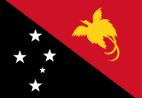
Papua New Guinea
Papua New Guinea is an island country in the Pacific, just off the northeast coast of Australia. It is a mountainous and largely rural country, with a wide and diverse range of cultures and languages.
HALO began our operations here in 2025. We're focusing on surveying, clearing explosives and delivering safety training.

Situation in Papua New Guinea
Papua New Guinea continues to grapple with the legacy of World War 2 explosives. This impacts the safety of the people and hinders development opportunities.
Papua New Guinea was a major WW2 battleground in the Pacific region. Extensive military operations by Allied and Japanese forces were based here. Massive quantities of munitions were stockpiled, used, and often abandoned.
Japan conquered the mainland and islands of Papua in 1942. The Allies retaliated through a series of beach landings on the islands and northern coast of New Guinea. These were intended to isolate the main Japanese base at Rabaul. Fierce land battles, naval and artillery bombardment, aerial bombing, and ammunition dumping have left their mark.
The explosion of the ammunition ship, USS Mount Hood, in Manus in 1944, was particularly catastrophic. It left behind thousands of tonnes of explosive remnants of war.

Impact of the bombs today

Decades later, explosive remnants still pose serious risks to the people of Papua New Guinea.
Over 25,000 people are estimated to have been injured or killed by explosives since 1945.
This contamination prevents farming, infrastructure development and safe housing.
The explosives also threaten the local ecosystem, as they are often repurposed by locals for fishing or other activities.
HALO's work and impact in Papua New Guinea
HALO has conducted three assessment missions to Papua New Guinea since late 2023, gathering evidence and establishing relationships with key stakeholders. Thanks to support from the United States Government, HALO began work in Oro Province and the Autonomous Region of Bougainville in July 2025.
Our first step is to survey mainland Papua New Guinea, New Guinea islands and the Autonomous Region of Bougainville to identify priority areas.
To support our work we'll use data from many sources, including:
Papua New Guinea Defence Force clearance data
US Theatre History of Operations reports
WW2 battle maps and histories
Multinational Operation Render Safe project

Developing skills and awareness

HALO will provide technical advice and training to local law enforcement teams. We'll also establish a team to respond and report on explosives found.
Another important part of our work is to deliver explosive safety training in affected communities. This will include classes and community meetings, posters, leaflets and children's workbooks.
We'll also use local radio and social media to raise awareness and encourage reporting of explosives.

Explosives clearance will improve livelihoods and development in isolated rural communities across Papua New Guinea
Across the country urban unemployment is very high and nearly 85% cent of the population are subsistence farmers.
HALO's work in Papua New Guinea is funded by:

Latest news from Southeast Asia
HALO programs in Asia


Donate to save lives today
Just $15 a month can make a difference