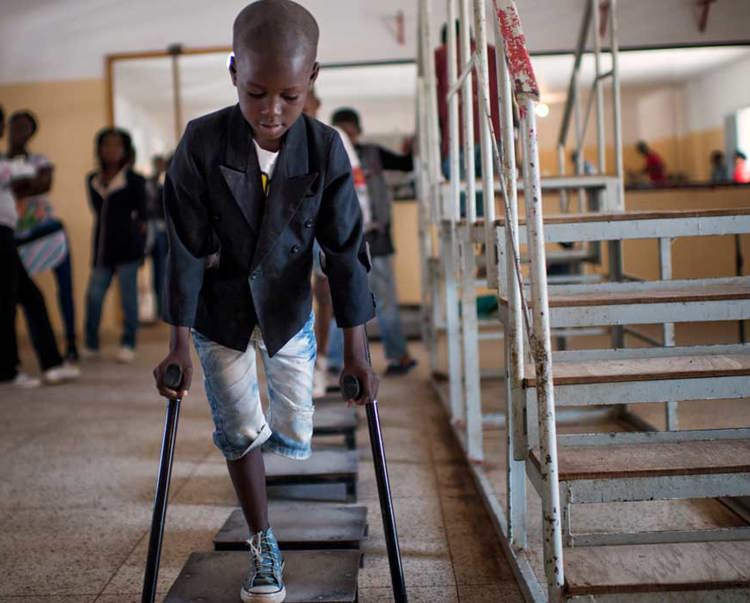
Promoting good health
The threat of landmines and explosives goes beyond the immediate injuries. Conflicts often lead to complex public health crises. These hidden dangers can have severe long term consequences for the health and wellbeing of the local communities.
By making land safe, we help to prevent devastating injuries, we enable people to grow crops and we create safe pathways to reach medical care. As well as removing the physical threat, we help to rebuild the foundations of a healthy society.
Our mine clearance work directly impacts three key public health issues:

Disability and death
6,279 people were killed or injured by landmines and explosive remnants in 2024, according to Landmine Monitor.

Malnutrition
733 million people were malnourished in 2024, according to Action Against Hunger. Unsafe farmland impacts food availability.

Access to health clinics
Damaged medical facilities and transport routes make it difficult for communities to access healthcare, especially in rural areas.
Community health programmes

Victim assistance
HALO partners with organisations around the world to provide prosthetics and other medical care to victims of landmines. Our programmes in Angola and Zimbabwe have provided many people with prosthetic limbs, helping them to rebuild their lives after devastating injuries.

First aid responder training
HALO provides Community First Aid Responder Training with a focus on blast injuries, haemorrhage control and children's injuries. The course is designed for people with no medical knowledge or equipment. Delayed medical response often leads to fatalities so this simple training can save lives in conflict zones.

Strengthening health systems
HALO partners with the Royal College of Surgeons Edinburgh to provide clinical training to medical professionals around the world. In some regions, local medics may have only had rudimentary medical training, so improving their skills positively impacts the health of the whole community.
Staff training programmes

Medic training
In partnership with the Royal College of Surgeons Edinburgh, HALO provides specialised training to our medical staff to improve care standards. All programmes' Chief Medical Officers attend regular training sessions and receive ongoing professional development support.

Mental health support
Traumatic events experienced by deminers can take their toll on our staff's mental health. We've recently launched Trauma Risk Management training in partnership with March on Stress to provide psychological support to our staff. Training has begun for HALO teams in Indo-Pacific, Ukraine and head office.

General health training
All staff are given guidance on how to look after themselves when working in hazardous and remote areas. They are trained in wide-ranging subjects including trauma awareness, infectious diseases, water and sanitary hygiene, psychological health, nutrition and general health and wellbeing.
Women's health initiatives

Period kits
Menstrual health is a critical aspect of women's wellbeing, but it can be a challenge for women working in remote minefields. We partner with Days for Girls to provide our staff with period products, give training in how to use them effectively, and run sewing training to help them make their own.

Support for new mums
Staff returning to work after giving birth often face logistical and financial problems. HALO runs programmes in Angola, Laos, Sri Lanka, and the Horn of Africa to address this. We provide staff with boxes of essential newborn supplies and nutritional supplements for new mothers. We also provide childcare stipends.

Women's health education
HALO provides training to women on all aspects of their health. We also equip women with the tools and resources to help them combat violence.
Partnering with RCSEd
The HALO Trust had recently signed a partnership agreement with the Royal College of Surgeons Edinburgh (RCSEd). We'll be working closely with their Faculties of Prehospital Care, and Remote, Rural and Humanitarian Healthcare across three main areas:
- Education: we'll help to develop learning materials by testing them to make sure they reflect the realities on the ground. Our medical staff will have access to events and online learning materials.
- Research: we'll collaborate on research on blast injuries and prehospital care in remote and dangerous environments.
- Health systems: we'll use our established logistics networks to help RCSEd’s clinicians to access remote places where health systems are under-resourced. This will strengthen health systems and leave a lasting legacy.

RCSEd and HALO teams sign landmark agreement
Mine clearance safety

HALO takes safety very seriously and a number of aspects are in place to protect our staff:
- Rigorous safety standards and procedures, approved by the national authority of each country eg blast-proof PPE, safety distances
- Regular, unannounced safety inspections by national authorities
- Medical Board overseeing casualty evacuation procedures and staff health issues
- Regular field visits by the Medical Board to give training and monitor safety standards
Despite our robust measures, accidents inevitably occur when handling deadly explosives. If an unplanned detonation takes place we take these steps
- Thorough internal investigation
- Engage independent investigators for serious accidents or injury
- Update operating procedures with safety improvements
HALO's fatality rate is in line with other mine clearance operators.
In 2018, to mark our 30th anniversary, we held a multi-faith service of remembrance for everyone who has died in HALO's service. We also commemorate our fallen colleagues every year on World Humanitarian Day. We remain indebted to them all for their courage in working to make others safe.
Stories on healthcare


HALO's work in this area is funded by: